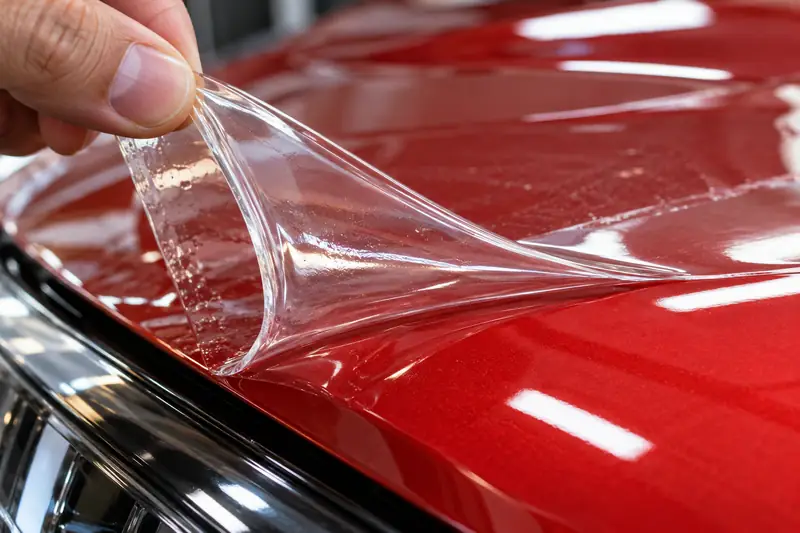
PPF · 7 min read
What is TPU? Thermoplastic polyurethane explained and why PPF uses it
Thermoplastic polyurethane (TPU) explained: what TPU means, its chemistry, polyester vs polyether, aliphatic vs aromatic, and why PPF uses aliphatic TPU film.
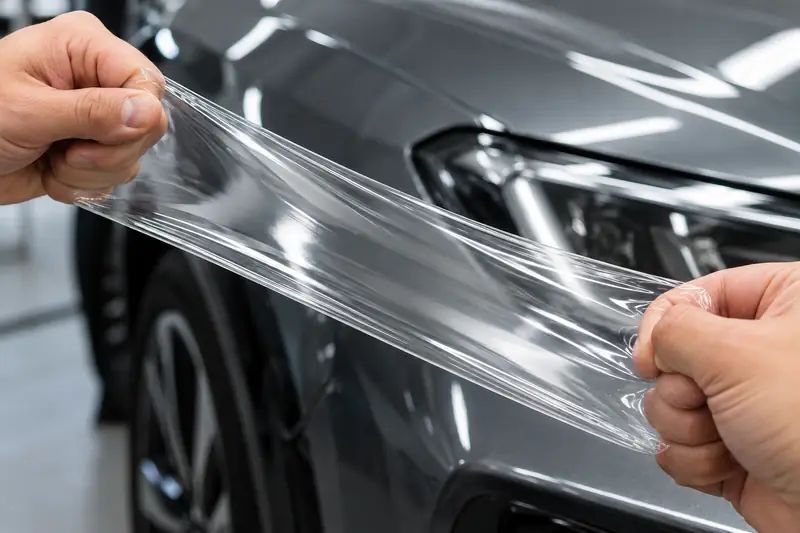
Short answer: Thermoplastic polyurethane (TPU) is a melt-processable elastomer made of alternating hard and soft polymer segments, giving it rubber-like stretch with plastic-like toughness. Paint protection film uses clear aliphatic TPU because it stays transparent and resists yellowing under UV, absorbs stone impacts, conforms to curves when warmed, and carries a self-healing top coat.
Thermoplastic polyurethane, usually shortened to TPU, is a family of elastic plastics that combine the stretch and recovery of rubber with the toughness and clarity of an engineering plastic. TPU is used in phone cases, hoses, shoe soles, medical tubing and, in clear film form, as the base layer of modern paint protection film. This explainer covers what TPU means, how its chemistry works, the main types (polyester vs polyether, aliphatic vs aromatic), key material properties, and why PPF makers choose aliphatic TPU. It is written for installers, distributors and curious car owners who want an accurate, plain-English picture.
Key takeaways
- TPU stands for thermoplastic polyurethane: a polyurethane that softens when heated and can be melted, extruded or cast, then re-melted, unlike thermoset polyurethanes.
- TPU is a block copolymer: hard segments give strength and heat resistance, soft segments give elasticity.
- Polyester-based TPU has strong abrasion and oil resistance; polyether-based TPU resists hydrolysis and stays flexible in the cold.
- Aromatic TPU yellows in sunlight; aliphatic TPU stays clear, which is why quality PPF uses aliphatic TPU.
- PPF is a layered product: an aliphatic TPU base film, an acrylic adhesive and a self-healing polyurethane top coat.
What does TPU stand for?
TPU stands for thermoplastic polyurethane. Each part of the name means something:
- Thermoplastic: the material softens and flows when heated and hardens again when cooled, so it can be processed like other plastics and, in principle, re-melted.
- Polyurethane: the polymer chains are linked by urethane groups, formed when an isocyanate reacts with a polyol (an alcohol with several reactive OH groups).
"TPU plastic" and "TPU rubber" both describe the same family; it sits between the two, so it is often called a thermoplastic elastomer (TPE).
How TPU is made: hard and soft segments
TPU is built from three raw materials:
- A diisocyanate, such as MDI (aromatic) or HDI, H12MDI or IPDI (aliphatic).
- A long-chain polyol, usually a polyester, polyether or polycaprolactone, which forms the soft segment.
- A short-chain diol chain extender, commonly 1,4-butanediol, which reacts with the isocyanate to form the hard segment.
The result is a linear segmented block copolymer. Along each chain, short rigid hard segments alternate with long flexible soft segments. The hard segments cluster together through hydrogen bonding into small domains that act like physical cross-links, holding the material together at room temperature. When the material is heated, those domains loosen and the TPU can flow; when it cools, they re-form.
That reversible structure is what separates TPU from thermoset polyurethanes such as many foams and two-component coatings, whose chains are chemically cross-linked and cannot be re-melted.
TPU vs PU: what is the difference?
PU (polyurethane) is the broad family; TPU is one type within it.
| TPU (thermoplastic polyurethane) | Other PU (thermoset polyurethane) | |
|---|---|---|
| Structure | Linear chains with physical cross-links | Chemically cross-linked network |
| Re-meltable | Yes | No |
| Processing | Extrusion, injection molding, film casting | Reactive molding, spraying, foaming |
| Typical forms | Film, sheet, tubes, molded parts | Foams, coatings, rigid parts, adhesives |
| Examples | PPF base film, phone cases, hoses | Seat foam, acrylic polyurethane paint |
Acrylic polyurethane is a different product again: a two-component coating made from an acrylic polyol and an isocyanate hardener. Many automotive clear coats and acrylic polyurethane paints are of this type. They are thermosets, so they are not TPU, even though both contain urethane links.
Types of TPU: polyester vs polyether
The soft segment decides much of a TPU grade's behavior.
| Property | Polyester TPU | Polyether TPU | Polycaprolactone TPU |
|---|---|---|---|
| Abrasion and tear resistance | Very good | Good | Very good |
| Oil and fuel resistance | Very good | Moderate | Good |
| Hydrolysis (water and humidity) resistance | Lower | Very good | Better than standard polyester |
| Low-temperature flexibility | Good | Very good | Good |
| Microbial resistance | Lower | Very good | Moderate |
Polyester grades are strong and tough but can slowly break down in hot, humid conditions. Polyether grades handle water and humidity better and stay flexible in cold weather. Polycaprolactone, technically a polyester, offers a middle ground with better hydrolysis resistance than standard polyester TPU. Film makers choose and formulate grades for the balance they need; PPF base films are commonly polyester or polycaprolactone based, with polyether grades also used.
Aliphatic vs aromatic TPU
The isocyanate decides how TPU reacts to sunlight.
- Aromatic TPU uses isocyanates with benzene rings, mostly MDI. It is strong and widely used, but aromatic structures absorb UV light and form colored compounds, so the material yellows over time outdoors.
- Aliphatic TPU uses isocyanates without benzene rings, such as HDI, H12MDI or IPDI. Aliphatic polyurethane is light-stable: it stays clear and color-stable in long UV exposure.
Aliphatic TPU costs more to produce, which is one reason cheap clear films sometimes yellow while quality films do not. For anything transparent that lives outdoors, aliphatic is the right choice.
TPU material properties
Exact values depend on the grade, but typical thermoplastic polyurethane material properties include:
- Hardness: roughly 60 Shore A (soft, rubbery) to about 75 Shore D (rigid).
- Density: typically around 1.1–1.25 g/cm³.
- Elongation at break: often several hundred percent.
- Clarity: many grades are transparent; clear TPU film can be optically very clean.
- Temperature range: stays flexible well below freezing and holds shape at summer surface temperatures, depending on grade.
- Abrasion and impact resistance: high, which is why TPU is used for wheels, belts and protective films.
Is thermoplastic polyurethane flexible?
Yes. TPU is valued for being flexible and elastic: it stretches, absorbs impacts and recovers its shape. Harder grades are stiffer, but film grades used in PPF are soft enough to stretch over bumpers and mirrors when warmed.
Is TPU safe?
TPU is generally considered a low-hazard material in normal use and is used in many consumer and medical products. Unlike flexible PVC, it does not rely on added plasticizers for flexibility. As with most plastics, burning it releases harmful fumes, so shops should follow the supplier's safety data sheet for handling, cutting and disposal.
Why paint protection film uses aliphatic TPU
TPU paint protection film is a multilayer product. A typical PPF construction, from top to bottom:
- Protective cap sheet, removed after installation on some films.
- Self-healing top coat, a thin cross-linked elastomeric polyurethane coating, typically a few microns to around 10–15 µm.
- Aliphatic TPU base film, commonly around 150 µm (about 6 mil).
- Acrylic pressure-sensitive adhesive.
- Release liner, often PET, removed before installation.
Total film thickness, excluding the liner, is commonly about 7.5–8.5 mil (190–215 µm).
Aliphatic TPU suits this job because it:
- Stays clear and resists yellowing under years of UV.
- Absorbs impact from stones and grit, spreading the energy instead of chipping.
- Stretches when warm and conforms to complex curves, then holds shape.
- Bonds well with the top coat and adhesive layers.
The self-healing effect comes mainly from the elastic top coat. Light swirls and wash marks flatten out when the film is warmed, by sun, warm water or a heat gun, because the cross-linked coating returns to its original shape. Deep cuts through the coating will not heal.
For comparisons with cheaper materials, see TPU vs TPH vs PVC PPF and TPU vs PET vs PVC car wrap film. For a general introduction, read what is paint protection film.
Other uses of TPU film
Clear TPU appears well beyond car paint:
- Windshield protection film in TPU form; see our windshield protection film guide.
- TPU screen guards for phones and tablets.
- Thermoplastic polyurethane sheet for inflatable products, waterproof fabrics and laminates.
- TPU resin pellets for 3D printing filament, cable jackets and molded parts.
Sourcing TPU film for PPF
When comparing thermoplastic polyurethane suppliers and manufacturers for PPF, ask whether the base film is aliphatic, request thickness and top coat data, and test clarity, stretch and self-healing on a real panel. Mars Decorative Film makes clear TPU PPF and self-healing color PPF on 1.52 m rolls with batch numbers and roll-by-roll inspection, available under your own label through our OEM program. Shops can request free samples to test before stocking.
Frequently asked questions
What is TPU?
TPU is thermoplastic polyurethane, an elastic plastic made of alternating hard and soft polymer segments. It can be melted and processed like a plastic but stretches and recovers like rubber, and it is used in film, tubing, phone cases, footwear and paint protection film.
What does TPU stand for?
TPU stands for thermoplastic polyurethane. "Thermoplastic" means it softens when heated and can be reshaped, and "polyurethane" means its polymer chains are connected by urethane groups.
What is TPU plastic?
TPU plastic is a thermoplastic elastomer, a material between rubber and rigid plastic. It is tough, abrasion resistant, flexible and can be transparent, which makes it useful for protective films and cases.
Is thermoplastic polyurethane flexible?
Yes. Most TPU grades are flexible and elastic, with high elongation before breaking. Harder grades exist, but the film grades used for PPF stretch over curves when warmed and recover their shape.
What is the difference between TPU and PU?
PU is the broad polyurethane family, including thermoset foams and coatings that cannot be re-melted. TPU is the thermoplastic type within that family, with linear chains that can be melted and re-processed into film, sheet or molded parts.
Why is aliphatic TPU used for PPF?
Aliphatic TPU does not contain the aromatic rings that absorb UV and turn yellow, so it stays clear for years outdoors. Combined with its impact absorption and stretch, that makes it the standard base material for quality paint protection film.