Tools & installation · 8 min read
Adhesion promoter for vinyl wrap: primer, edge sealer and when to use them
Adhesion promoter for vinyl wrap explained: what wrap primer does, where to apply it, plastic and paint decontamination prep, edge sealer and when to skip it.
Short answer: An adhesion promoter is a thin primer that increases the bond between pressure-sensitive adhesive and a surface. In vinyl wrapping it is applied only to high-risk spots such as recessed edges, deep channels, door handle cavities and low-energy plastics, after full decontamination. It is not used on whole panels, and it can make later wrap removal harder.
An adhesion promoter is a thin, usually clear primer that helps pressure-sensitive adhesive grip a surface more strongly than it would on its own. In vehicle wrapping, a vinyl wrap adhesion promoter is a precision tool rather than a general coating: installers use it on the few areas where film is most likely to lift, such as recessed edges, deep channels and hard-to-bond plastics. This guide explains what adhesion promoter does, where to use it and where not to, how it fits into car wrap prep and paint decontamination, and how it differs from edge sealer. It is for wrap installers, shop owners and experienced DIY wrappers.
Key takeaways
- Adhesion promoter is a primer that raises the bond strength of adhesive on difficult surfaces; it is applied in thin, targeted strips, not across whole panels.
- It is most useful on recessed edges, inside door handles, deep body lines and low-surface-energy plastics such as some bumpers and trim.
- It only works on a surface that is already fully decontaminated and wiped with isopropyl alcohol.
- Using it widely can make a wrap much harder to remove and may risk lifting paint when the film comes off.
- Edge sealer is different: it is applied over a finished vinyl edge to protect it, whereas adhesion promoter goes under the film.
- Do not wrap over bare or unsealed primer; vinyl needs a fully cured, sealed paint surface.
What is an adhesion promoter?
An adhesion promoter is a dilute solution of polymer resins, often chlorinated polyolefin or similar, in fast-evaporating solvents. After the solvent flashes off, it leaves an extremely thin film that bonds well to the substrate and offers the vinyl's adhesive a more receptive surface.
You will see several product forms:
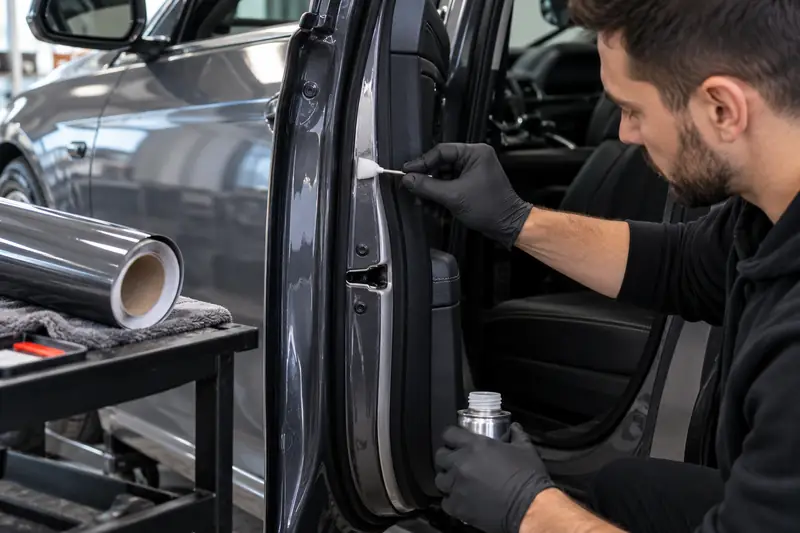
- Pen or felt-tip applicators that lay a narrow line exactly where needed, popular with wrappers.
- Wipes or sponge-tip ampoules for small areas.
- Bottles used with a lint-free swab.
- Adhesion promoter spray cans, used more often in painting and trim mounting than in wrapping, where overspray is a problem.
Most wrap-oriented products are a clear adhesion promoter, so a small overrun beyond the film edge is not very visible, though it still collects dirt and should be wiped off before it dries.
Why vinyl wrap sometimes needs a primer
Wrap film is designed to stick to clean, cured automotive paint without help. Problems appear where the film is under tension or the surface resists bonding:
- Recesses and deep channels. Film stretched into a recess wants to return to its flat shape and pull out of the channel.
- Edges wrapped around tight returns. The film has less adhesive contact and more stress.
- Low-surface-energy plastics. Polypropylene and TPO bumpers and some unpainted trim resist adhesive.
- Textured plastics, where only the peaks of the texture touch the adhesive.
- Areas exposed to fuel, washing jets or heat, such as fuel doors and areas near exhausts.
In these spots a car wrap primer can be the difference between a clean job and a comeback.
Where to use adhesion promoter on a wrap
Use it sparingly and only where it adds real value.
| Area | Use adhesion promoter? | Why |
|---|---|---|
| Flat panel faces (doors, hood, roof) | No | Film bonds well on clean paint; makes removal harder |
| Recessed door handle cups | Often | High stretch and tension in a deep recess |
| Deep bumper channels and intakes | Often | Film tends to lift out of deep recesses |
| Panel edges where film wraps around | Sometimes | A narrow strip helps hold the return |
| Unpainted textured plastic trim | Sometimes | Low surface energy; test first |
| Mirror caps and spoilers | Sometimes | Complex curves and high wind load |
| Inlays and seams on paint | Rarely | Usually handled by overlap and post-heating |
The golden rule is a thin line where the film ends or is stretched hardest, not a coat over the whole area.
Adhesion promoter for plastic
Adhesion promoter for plastic is the most common use outside wrapping: body shops apply it before painting bare bumpers, and trim installers use it before double-sided tape. Many automotive plastics, especially polypropylene and TPO, have a low surface energy, so liquids bead up and adhesives grip poorly.
For wrapping, keep three points in mind:
- Painted bumpers already have a primer and paint system on them, so they usually behave like any painted panel.
- Unpainted textured trim benefits most, but film on heavy texture can still look uneven, so many shops wrap only smooth trim.
- Test first. Apply promoter and film to a hidden area, let it rest overnight, and check the bond.
The best adhesion promoter for plastic is the one whose data sheet lists the specific plastic you are working on and confirms compatibility with pressure-sensitive adhesives.
How to apply adhesion promoter
Adhesion promoter sits inside the wider car wrap prep process. It goes on last, after cleaning, just before the film.
- Wash the vehicle with a dedicated prep shampoo that leaves no wax or gloss enhancers.
- Decontaminate the paint. Use an iron remover and tar remover, then clay the surface (see the next section).
- Remove trim and hardware where the plan calls for it, so edges can be wrapped properly.
- Wipe with isopropyl alcohol. A 50–70% IPA solution removes remaining oils and residues.
- Mask if needed. On visible areas, low-tack tape keeps promoter on the exact line.
- Apply a thin, single pass of promoter with a pen, swab or wipe. Do not flood it.
- Let it flash off. Wait the time on the label, often around one to a few minutes, until it is dry to the touch.
- Apply the film within the working window stated on the product, then post-heat edges and recesses to the film's specified temperature.
Most promoters work best between roughly 15 and 30 °C (59–86 °F) in low humidity. For the full wrapping sequence see how to wrap a car.
Paint decontamination before wrapping
Paint decontamination is the removal of bonded contaminants that a normal wash leaves behind. Even the best primer for vinyl wrap cannot fix a dirty surface, because the adhesive bonds to whatever sits on the paint, not the paint itself.
Typical car paint decontamination steps:
- Chemical iron removal to dissolve embedded brake dust and rail dust particles.
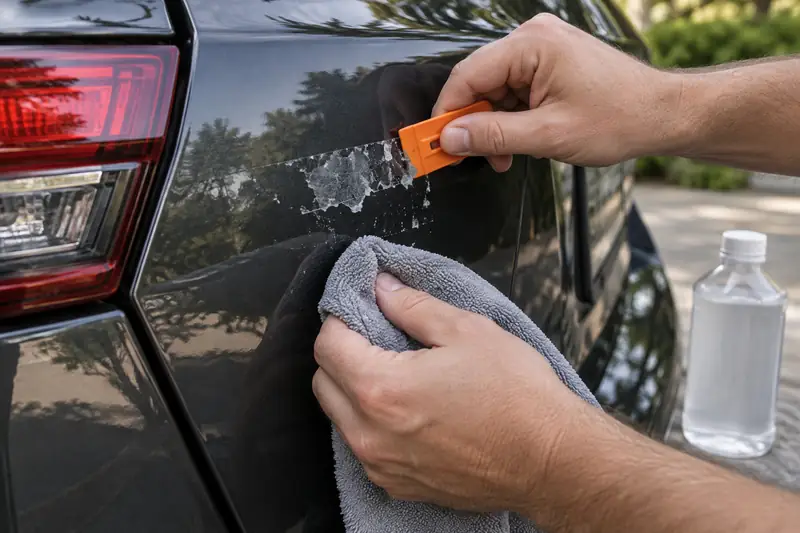
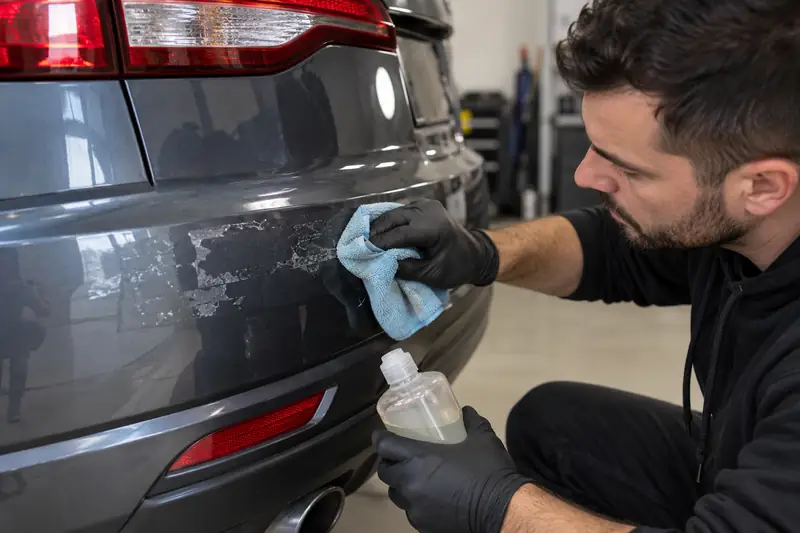
- Tar and adhesive removal to lift road tar, old sticker glue and residues. Our guide to adhesive remover for cars compares safe products.
- Clay bar or clay mitt to pull out remaining bonded particles so the surface feels glass-smooth.
- Final IPA wipe to strip lubricants, waxes and fingerprints.
Old waxes and silicone-rich sealants are a common reason wraps lift early. If the car was ceramic coated, the coating usually needs to be removed or at least checked with a test piece, because many coatings are designed to repel adhesion.
Vinyl wrap edge sealer vs adhesion promoter
A vinyl edge sealer is a clear liquid or tape applied over the finished edge of the film to keep water, dirt and wash chemicals out. Adhesion promoter goes under the film to improve the bond. They solve related but different problems.
| Adhesion promoter | Vinyl wrap edge sealer | |
|---|---|---|
| Position | Under the film, on the substrate | Over the film edge |
| Purpose | Stronger initial bond on hard areas | Protects the edge from lifting and dirt |
| Common use | Recesses, plastics, wrapped returns | Commercial graphics, edges exposed to washing |
| Appearance | Invisible when done well | Can leave a visible line if overapplied |
| Removal impact | Makes film harder to remove | Must be cleaned off when removing the wrap |
On color-change wraps, many installers prefer good technique and proper post-heating over edge sealer, saving sealer for cut edges on graphics that face pressure washing.
Can you vinyl wrap over primer?
Not on bare, unsealed primer. Primer is porous and not designed to hold a pressure-sensitive adhesive long term; the film may bond to loose primer and then pull it off, or primer solvents can outgas and cause bubbles. Paint that is fresh from a respray also needs time to cure, commonly several weeks, before wrapping. The surface should be fully painted, cured, clean and smooth. If a panel has been repaired, ask the body shop for its cure time.
Supplies for wrap shops
Mars Decorative Film does not make adhesion promoters, edge sealers or cleaning chemicals, so source those from a specialist supplier and follow their data sheets. We supply the films and hand tools for the install itself: PVC vinyl wrap and PET liner vinyl on 1.52 m rolls, plus wrap tools such as squeegees, knives and tapes. Shops can request free samples and test them with their own prep system. See also our full vinyl wrap tools kit guide and heat gun guide for post-heating.
Frequently asked questions
Do you need adhesion promoter for vinyl wrap?
Not on most panels. Clean, cured paint gives good adhesion on its own. Adhesion promoter is useful in small, targeted areas such as deep recesses, door handle cups, wrapped edges and low-energy plastics where film is likely to lift.
Can you vinyl wrap over primer?
You should not wrap over bare or unsealed primer. It is porous, can be pulled off with the film and may outgas into bubbles. Wrap only over fully painted, cured and cleaned surfaces.
What is the difference between adhesion promoter and primer?
In wrapping the terms are often used interchangeably. An adhesion promoter is a very thin primer designed to improve the bond of adhesive or paint on difficult surfaces, whereas a paint primer is a thicker build layer used under paint.
Does adhesion promoter make a wrap harder to remove?
Yes. Areas treated with promoter hold the film more strongly, so removal takes more heat and time, and there is a higher chance of adhesive residue. That is why installers apply it only in narrow strips where it is needed.
What is a vinyl wrap edge sealer?
It is a clear liquid or tape applied over the edge of finished film to stop water, dirt and wash chemicals from getting under it. It is used most on cut edges of graphics and areas exposed to frequent washing.
How do you prep a car for vinyl wrap?
Wash with a prep shampoo, decontaminate with iron remover, tar remover and clay, remove hardware where needed, and wipe every surface with isopropyl alcohol just before applying film. Use adhesion promoter only on high-risk recesses and edges.